
If you live or work in Lagos, your daily calendar contains an invisible, exhausting second job: navigating traffic. Whether sitting through standstill traffic on the Lekki-Epe Expressway, crawling across the Third Mainland Bridge, or braving the rush-hour bottleneck at Ikeja Along, the average Lagos resident spends 3 to 5 hours every single day inside a vehicle.
While most people view traffic as a purely psychological inconvenience, sports scientists and somatic therapists recognize it as a severe, chronic stressor known as Traffic Stress Syndrome (TSS).
When you spend hours sitting in a constrained position, your body suffers subtle, cumulative physical damage. This comprehensive guide breaks down the biomechanics of traffic strain and explains how transitioning to home-service massage therapy completely eliminates the physical and neurological toll of the Lagos commute.
The Biomechanics of “Commuter Body”: What Hours in Traffic Do to You
The human frame was not designed for prolonged, motionless sitting—especially in high-stress environments. When you drive or commute in heavy traffic, your body undergoes four distinct physiological strain factors:
[Constant Braking / Accelerating] ---> [Pelvic Tilt & Asymmetry]
                                               |
                                               v
[Static Sitting + Road Vibrations] ---> [Disc Compression & Lower Back Pain]
1. Pelvic Asymmetry and Driver’s Hip
When driving, your right leg is constantly active—alternating between the accelerator and brake pedal—while your left leg remains idle. This asymmetric movement forces your pelvis into a micro-rotation, pulling on the psoas and piriformis muscles. Over time, this imbalance causes sharp lower back pain and tight hips.
2. Micro-Vibration Fatigue
Vehicles emit constant low-frequency vibrations from the road surface and engine. To keep your spine stable against these micro-shocks, your deep spinal stabilizer muscles (the multifidus) remain in a continuous, involuntary contraction. This leads to deep, aching back fatigue by the time you reach your destination.
3. Hyper-Vigilant Shoulder Elevation
Gripping a steering wheel in chaotic traffic forces your body into a constant sub-conscious “fight-or-flight” state. Your shoulders unconsciously elevate toward your ears, locking the upper trapezius and levator scapulae muscles into tight, painful knots.
The “Post-Spa Commute Rebound”: Why Traditional Spas Fail Commuters
Many Lagos professionals attempt to solve traffic stress by visiting a traditional brick-and-mortar spa after work. However, this approach suffers from a fundamental design flaw: The Post-Massage Rebound Effect.
When you finish a restorative 60-minute massage at a commercial spa, your parasympathetic nervous system is fully activated. Your blood pressure drops, your heart rate slows, and your muscles become soft and pliable.
However, the moment you step out of the spa and drive back into Lagos traffic:
-
Your nervous system gets jolted back into hyper-vigilance.
-
Your newly relaxed muscles tense up immediately to handle the wheel.
-
Your cortisol levels spike, effectively neutralizing up to 80% of the therapeutic benefits you just paid for.
3 Reasons Home-Service Therapy is the Ultimate Recovery Tool
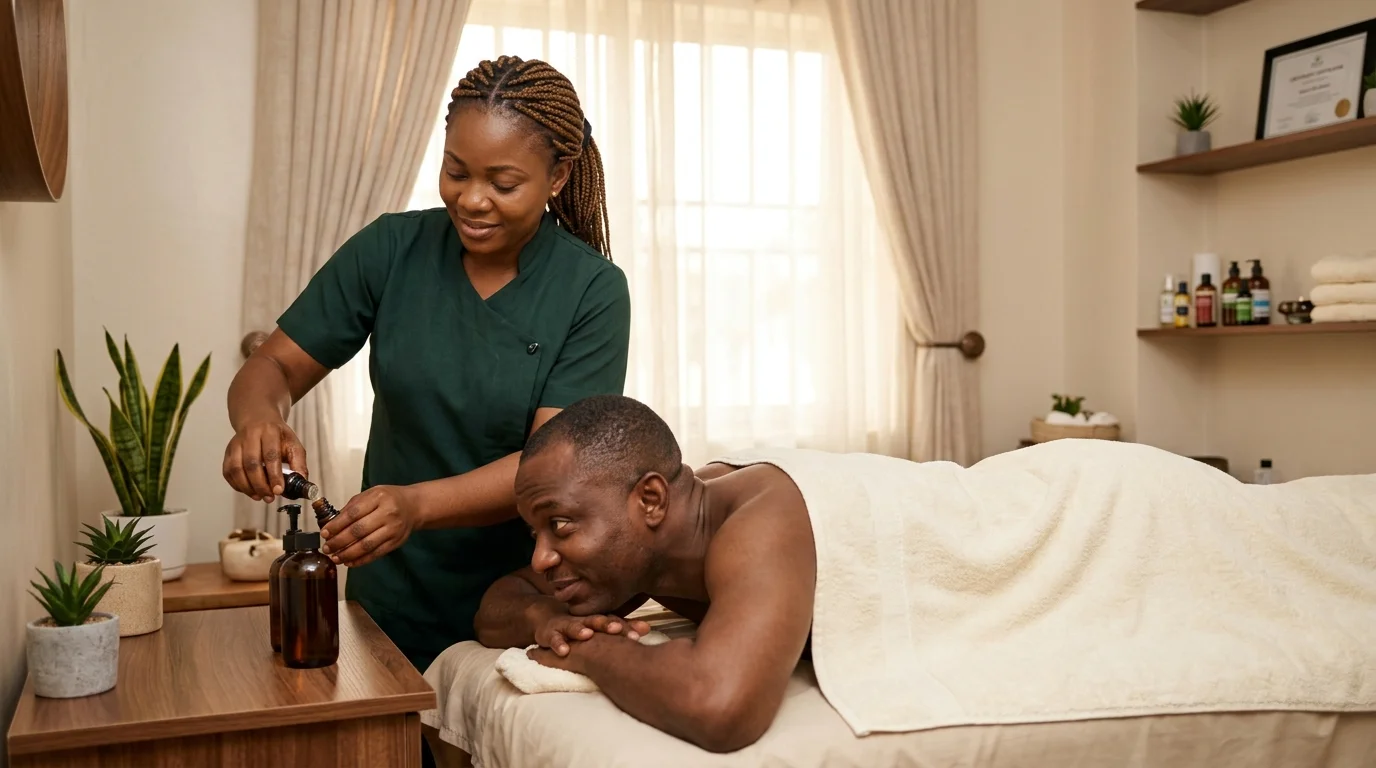
To achieve lasting somatic relief, the transition from a massage back into rest must be unbroken. In-home massage therapy changes the equation entirely.
| Factor | Traditional Commercial Spa | Home-Service Spa Therapy |
| Post-Treatment Transition | Navigating 1-2 hours of traffic | Stepping straight into your shower or bed |
| Nervous System Impact | Immediate stress rebound | Sustained parasympathetic “Rest & Digest” |
| Schedule Control | Fixed appointment windows | Flexible timing around peak traffic hours |
| Environment | Foreign room setting | Your familiar, secure, climate-controlled space |
1. Unbroken Muscle Assimilation
After deep tissue manipulation, your muscle fibers require time to settle without sudden tension. Receiving treatment at home allows your body to stay horizontal, letting the hyper-oxygenated blood settle into damaged tissue for maximum recovery.
2. Superior Sleep Architecture
Traffic stress elevates evening cortisol, making deep sleep difficult to achieve. A late-afternoon or evening home massage triggers a massive surge in melatonin and serotonin. By avoiding a post-treatment commute, you can transition directly into deep REM sleep.
3. Time Reclamation
Eliminating the travel time to and from a spa reclaims an extra 2 to 3 hours of your evening. This time can be redirected toward family, hobbies, or genuine, uninterrupted downtime.
Customizing Your Home Recovery Session
To maximize your recovery from traffic-induced strain, communicate your specific pain points to your home massage therapist before the session begins:
-
Target the Posterior Chain: Ask the therapist to focus heavily on the glutes, piriformis, and hamstrings to unlock pelvic tightness caused by pedal usage.
-
Integrate Cervical Traction: Gentle neck traction and suboccipital release help undo the forward-head posture caused by staring through a windshield for hours.
-
Incorporate Heat Therapy: Warm towels applied to the lower back before deep tissue work help melt stiff fascia, allowing the therapist to work deeper with less discomfort.
Conclusion: Take Control of Your Daily Recovery
While you cannot single-handedly fix Lagos traffic, you have total control over how your body recovers from it. Continuing to push through chronic driver fatigue leads directly to long-term spinal issues, chronic fatigue, and career burnout.
By integrating regular, professional home-service massage therapy into your weekly routine, you turn your home into a sanctuary of health—ensuring that the stress of the road stops at your front door.